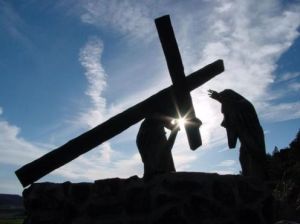
Gatekeepers (via Nick Baines’s Blog)

Bouncers or welcomers?
This is a subject close to my heart, and +Nick has expressed my feelings on it beautifully.

Gatekeepers One of the things that I find most challenging about the Gospels is that they drive a coach and horses through easy assumptions about God and those who take God seriously. It’s no wonder that some Christians find Paul easier to handle (he develops arguments) than Jesus (he gives pictures). I came to the conclusion a long time ago that we should read Paul in the light of the Gospels and not the other way round. Discuss… Anyway, one of the glarin … Read More

via Nick Baines’s Blog

Cascades of Grace

Panning for gold.. I have done it a few times, usually with children- standing with a sieve/pan usually in cold water, scanning through an awful lot of grit and gravel to see if there is the teeniest glint of gold. Didn’t feel dissimilar to what I have spent the last few weeks doing – trawling through many many books for essay research.  I never did find any of the real stuff- but I have this time around.

I am writing about taking a congregation through the sometimes tricky and painful process of change, and looking at the subject from a whole variety of angles.  Fear not, I will not be foisting my essay on an unsuspecting public – but I thought a few of the nuggets I found along the way were definitely worth sharing.  They were worth finding, regardless if I can use them in the essay or not..

John O’Donohue, late poet/writer/thinker/priest, is writing about the intoxicating combination of hope and insight.      “Some of the most decisive moment in one’s life are when someone shows you a new frontier and helps you across into a world of new possibilities and promise. To be helped towards a new way of seeing is to be given access to a whole new world. At its highest point of intensity and possibility Meister Eckhart refers to this as the Birth of God in the Soul” 

“the Birth of God in the Soul” what a wonderful way of expressing it! Perhaps it particularly appeals to me, as a former midwife. Being a ‘spiritual midwife’ is very much part of what I see priesthood being about. Helping to birth God in the souls of others. It was an awesome privilege to deliver each of the  precious babies I brought into the world. A wonder that I never got blasé about.  My last delivery ever, was undiagnosed twins on a GP unit ( the 2nd one, a breech) but that is another whole story.

Going back to nursing, I took up palliative care nursing- very much a type of ‘midwifery’ at the other end of life. Travelling barefoot with individuals and their families on the Holy ground of the approach to death. Both birth and death involve the whole family, and are perhaps the most dramatic points of change that happen to any of us. Both types of midwifery involve reducing the fear, and the pain and retaining as much dignity as possible. Both involved   (for me anyway) staying with the person in and through the pain, physical or psychological. Accompanying with compassion. ( the Latin root of the word compassion means ‘to suffer together with’  . A costly, but precious privilege.

Travelling with individuals and more particularly with whole groups and congregations through the processes of change has many echoes of both sorts of midwifery.  I loved the way Ann Morrisy in the book Journeying Out  uses the phrase ‘cascades of Grace’  to describe what happens when a congregation starts to look and then move outwards into the community, perhaps for the first time.

Willingness to be alongside those who know deeply about struggle, are without power and aware of the possibility of being overwhelmed is what venturesome love is all about.  Community ministry involves the provision of structures that enable people to express venturesome love..”  

And in so doing, so venturing, start off a cascade of grace benefiting everyone involved.  Morrisy also links this with the miracle of the water in to wine.  Likening the church to the worried wedding hosts whose wine is running out.. what do we do?

What do they do? What do the servants do when they are given a nonsensical command by Jesus in response to the predicament? Go and fill up huge water jars with water ( no mean feat and involving a fair bit of work and effort) and then serve them up as if they were wine.  And behold, their obedience, their willingness to ‘journey out’ of common sense and comfort zones  result in the finest of wines  being available in abundance.  A cascade of grace. God’s extravagance revealed in the first miracle.

Returning to where I started.. crossing frontiers, entering new worlds. A wondrous but often frightening experience. In morning prayer today, the Old Testament passage was from Joshua chapter 1 . Joshua is about to take the people of Israel across the Jordan, into an unknown land. God speaks to him and says:

“I will not fail you or forsake you. ..Be strong and courageous; do not be frightened or dismayed. For the Lord your God is with you wherever you go. “

Only thing that counts.

All in a name


It was dark in the garden. It was dark in her heart. She had known plenty darkness before. The cold, eclipse of rejection. The pitch black of shame. The midnight of self hatred. But none like this. This was worse than all of those combined. Hope had been hammered out of her with the nails that they had roughly banged into his already broken, feet and hands. Even now, she didn’t know how she had stood there, and watched them do that to Him, except that she couldn’t tear herself away. The excruciating anguish of seeing his agony, and being helpless to do anything to help him, had torn her apart. That was Friday. A blur of pain and fire. Saturday she had been mute with grief, unable to think, or take anything else in. This morning she had forced her exhausted body to move. There was one more thing she could do for him.

This time, no one would see her, and criticize. No mocking words or sneers. She would pour her love  out for him for the last time. She would tenderly anoint his beloved, broken body with precious perfumed oils. This time, however, he would not smile at her. His scarred face would be still. His extraordinary eyes would be dull and closed forever.

She didn’t know how she was going to get past the guards, hadn’t a clue how she would move the stone with which they they had sealed his tomb. Nothing would stop her though. If it was the last thing she did, she would say her goodbye, and prepare his body properly for burial. That was the least she could do. What more had she got to lose?

Finding her way to the place she had seen his body hastily dumped, before the onset of the Sabbath, she was stopped in her tracks. They had taken even this last goodbye. Guards gone, the tomb gaping in yawning emptiness. They couldn’t even leave his body to rest in peace. Anger and confusion spurred her feet as she ran back to tell Peter and John of this final desecration. They ran too, looked and left. Unable to deal with themselves, unable to deal with her. She was left, and like at the foot of his cross, she couldn’t tear herself away, even though there was nothing to stay for. Nothing to live for. The tears flowed, as she wept for all that might have been. She had never known love and acceptance as this Man had showed her. Never experienced forgiveness and heartbreaking mercy that lifted her out of the dust, and breathed new life into her beaten down soul. She had watched him do it for so many others too, but now all that was gone.

The tomb was empty. The beloved body stolen, who knows where. She shuddered to think what they might have done with him. As if they hadn’t done enough. She looked again into the hollowed out space in the rock, wondering if she might at least gather his grave clothes. There were two men sitting in there, where his head and feet would have been. She couldn’t take in who they might be or why they were there. They asked her a stupid question.

Why are you crying?

WHAT ELSE DO YOU DO AT A GRAVE?!” she wanted to shout at them- “ isn’t it obvious?!”  “They have taken him away, and I have lost- everything”  She turned away – unable and unwilling to engage. Lost in her loss.

The sun was just rising, lifting over the city and bathing her in light. The light hurt almost more than the darkness. Another day. Another day he would never see. She folded in on herself.

There was a sound close by. A footstep. Suddenly concious of another person , who as she looked up, was standing in the brightness of the dawn. She could only see his outline, framed with light, and blurry with her tears.

Why are you weeping?”  the same question.

Gently and compassionately asked with a voice that sounded as if it cared about the answer.

Who are you looking for?” 

He could only be the gardener, but the question  reached right into her being. Right into the depths of her pain. Somewhere deep inside, in the darkness, there was the faintest glimmer of light.

If you know where he is, if you have moved him- tell me”  she pleaded. There was just a whisper of a chance she would find his body, after all.

He didn’t answer and she still couldn’t see his face, or read his expression. Silence. A pause in which the world turned, and her heart lifted towards hope, against herself.

Mary” 

No one else said it like that. No one else had ever put such unconditional love into the simple saying of her name. That beloved voice called her a second time out of a nightmare     of darkness, bringing her back to life.  It couldn’t possibly be – and yet it was. She had been looking for a corpse, and she had found a living Lord, who knew her, and called her by name.

Rabbouni!”   was all she had breath to say. She fell at his feet. The feet she had anointed with her tears; the feet she had seen hammered to the rough wood of the cross. Reaching out to hold them – she wanted to stay in this moment forever. Be sure it was real. That he was real. That her teetering mind hadn’t tipped finally, over the edge.

Gentle hands lifted her up. His smile was as wide as the sea, and the eyes she thought had closed for ever, twinkled with life and laughter. A name, a smile. A smile that reached out and found all the shattered pieces of her heart, and drew them together again, into a new whole.

Now go– and tell my brothers who you have seen”  he asked of her. Be the one to tell them I am alive. Be the Hope Bearer. Turn their lives upside down, as yours has been.

She didn’t hesitate. Carrying the good news- she ran with joy, in the glory of the rising sun, that was lighting up the world.

Slaughter of the innocents

A journey through Holy week  is not an easy one. The realities of the journey are harsh. It is easier, sometimes to let the familiar stories  slide off , as it is a risky business to go deeper. Sometimes a fresh angle takes my breath away. A new connection. An unexpected twist.  The following poem was one such angle.  Having known several years of infertility myself, it hit particularly close, when I came across it one Easter many years back. It is one that has stood in my memory since, retaining it’s power, and relevance.


How long we waited for a son, my man and I; 
Four times the seed miscarried, half formed the babe was cast away;
But to my anguished prayers at last, Jehovah bowed his head.
And beautiful as gold, my child lay curled within my arms
curving his tiny fingers round my thumb, laughing, crying,
his infant breath was mine and mine was his.
Deep the delight, the quiet joy of tiny mouth
seeking my breast, fulfilment for us both
as he fed there and I knew peace.
 
So blind and deaf with happiness, I did not hear of the decree.
Knew naught, until they came and dragged him from my arms,
raising the sword; there in our home
beside the fire, where late I suckled him
they slaughtered him, his radiant young blood outpoured in death.
 
The long grey years slipped by like ghosts.
Never again quickened my womb with child,
nor woke my heart to life nor love again.
 
And now I stand upon the hill called Golgotha
to tell you why I hated you, young Galilean.
For it was you he sought, that butcherer, that Herod.
Because of you, my babe was killed.
You, Jesus.
All through the years I hated you, I hated you
Til now, when as I heard them shouting  ‘ Crucify him!’
My heart sang loud with joy,
my babe, at last avenged
I cried, and took a stone to throw
but you fell, low beneath the burden of your cross.
And suddenly I saw your face, and looked into your eyes.
 
My suffering was there, engulfed in understanding
Lost in pain beyond the compassion of a human heart
You bore the burden of all other’s grief
and as you went, I knew you meant to die, for me.
 
It was as if my child were suddenly within my arms again
seeking the comfort of my breast.
The empty years were fled away
I thought I heard his infant laugh, who died for you
But now, as you too, walked the way of death
We shared the cross you carried,  part of a mighty pattern
you, my babe and me.
 
I knelt, a woman brought to life from death
as you passed by to Calvary.
 
Joan Brockelsby 


Matthew 2: 13-18

The Escape to Egypt

13 Now after they had left, an angel of the Lord appeared to Joseph in a dream and said, ‘Get up, take the child and his mother, and flee to Egypt, and remain there until I tell you; for Herod is about to search for the child, to destroy him.’ 14Then Joseph* got up, took the child and his mother by night, and went to Egypt, 15and remained there until the death of Herod. This was to fulfil what had been spoken by the Lord through the prophet, ‘Out of Egypt I have called my son.’
The Massacre of the Infants
16 When Herod saw that he had been tricked by the wise men,* he was infuriated, and he sent and killed all the children in and around Bethlehem who were two years old or under, according to the time that he had learned from the wise men.* 17Then was fulfilled what had been spoken through the prophet Jeremiah:
18 ‘A voice was heard in Ramah,
wailing and loud lamentation,
Rachel weeping for her children;
she refused to be consoled, because they are no more.’
 

Luke 13:31-35

The Lament over Jerusalem

At that very hour some Pharisees came and said to him, ‘Get away from here, for Herod wants to kill you.’ He said to them, ‘Go and tell that fox for me, “Listen, I am casting out demons and performing cures today and tomorrow, and on the third day I finish my work. Yet today, tomorrow, and the next day I must be on my way, because it is impossible for a prophet to be killed away from Jerusalem.” Jerusalem, Jerusalem, the city that kills the prophets and stones those who are sent to it! How often have I desired to gather your children together as a hen gathers her brood under her wings, and you were not willing! See, your house is left to you. And I tell you, you will not see me until the time comes when you say, “Blessed is the one who comes in the name of the Lord.” ’
 

Looking up

I lift up my eyes to the mountains—
where does my help come from?
My help comes from the LORD,
the Maker of heaven and earth.

Soaring mountains. They draw out the superlatives in us. Majestic. Awe- inspiring. Scary, even. Living among them briefly, last week, did me the power of good. What is it about such stunning beauty that lifts the heart and refreshes the spirit? For me, it is because they shout the glory of the God who made them. They feed my soul. I don’t want to conquer them or climb them. Soaring around their heights would be more my style. I watched hang-gliders do just that, and looked on in wistful wonder. But I was also happy just to sit and feast my eyes on the ever changing lights and shadows and colours. It is a view I would never tire of.

Looking up is always good.  It changes my perspective. Reminds me how little I am, and how big God is.

David ( who wrote alot of the Psalms) and I are old mates. We go way back. A shepherd boy poet/musician who poured out his heart and soul to the God he knew and loved. I could wax lyrical about many of the Psalms he wrote, but I’ll restrain myself to one . Psalm 61. (It is also about mountains.) It burned itself into my consciousness in my early teens.

Hear my cry, O God;

Listen to my prayer.

From the ends of the earth I call to you , when my heart is faint.

Lead me to the rock that is higher than I.

Lead me to the rock that is higher than I. “I” …such a little word. But it can tower over us,  It can block our view of others, and of God and it can certainly dominate our inner landscape.  Whether we view ourselves positively or negatively, self absorption is a habit that is ridiculously hard to shake off.  Young children go through a wonderful stage of unselfconsciousness. They just are. Like flowers or stars or mountains.   Then they start comparing themselves to others ( or are compared) .. and the trouble starts. Before they know it, puberty has hit and self consciousness goes through the roof.

The big ‘Who am I? ‘  questions really  start.. something I think we go on answering for the rest of our lives.  I had a strong sense of self from a very early age. I was one very stroppy toddler I am told ! ( individuating is the child development term… “I can decide things for myself and know where I begin, and others end” or “I can flex my will” )  I didn’t need to be a rebellious teen, I had done it all at 3!  My early teens, however coincided  with me being introduced to the Holy Spirit for the first time. ( God the Father and Son, I had been familiar with since birth). This encounter was in once sense, very ordinary and un-dramatic, and simultaneously, totally life changing. Perhaps I will make that encounter the subject of a blog post one day. The purpose of describing it here, is more about one of the effects.

It made me review myself with fresh eyes. I recognised the strength of my will, and personality, and wanted to reign myself in.  I was too big for me to handle, if that makes sense. Lead me to the rock that is higher than I . I needed to look up. I needed to know that my life rested in bigger, wiser hands than mine. Someone who knew me better than I would ever know myself. Someone who had loved me from my earliest beginnings, and had called me by name.

External pressures can be overwhelming at times, but internal pressures can be even more so. The deep, half hidden pressures we put on ourselves, to perform, to be perfect, to live up to whatever we think or have been made to believe we should be/do… these are just some of them. These are the real stressors, in my experience. They can be what takes the load to breaking point. “From the ends of the earth I call to you when my heart is overwhelmed. Lead me to the rock that is higher than I.

I long to dwell in your tent forever, to take refuge in the shelter of your wings.” Sometimes we need to take refuge from the world, but more often I think, we need to take refuge from ourselves. Our wills, our self consciousness, our inner drivers and pressures. I know I do.        I need to look up . I need to get myself in perspective, and lose myself in the vastness of God.

I lift up my eyes to the mountains—
where does my help come from?
My help comes from the LORD,
the Maker of heaven and earth. ( Psalm 121)


Paul Baloche has interpreted Psalm 61 in a song. From a CD called Compassion Art.

Who do you see?

Dinner with friends. Relaxed, familiar environment. No surprises. Or so we thought. I should know by now, it is always different with him. People react. All sorts of ways – they love him, they hate him, but they always react to him. It had been tense for a while. The rumours were flying. We were laying low. The authorities were muttering, and when they start muttering, somebody ought to start worrying. Well I was worrying. No idea what was coming next, but I had a bad feeling it wasn’t going to be fun.

John 12 (Amplified Bible)

John 12

1SO SIX days before the Passover Feast, Jesus came to Bethany, where Lazarus was, who had died and whom He had raised from the dead.2So they made Him a supper; and Martha served, but Lazarus was one of those at the table with Him.

3Mary took a pound of ointment of pure liquid nard [a rare perfume] that was very expensive, and she poured it on Jesus’ feet and wiped them with her hair. And the whole house was filled with the fragrance of the perfume.

4But Judas Iscariot, the one of His disciples who was about to betray Him, said,

5Why was this perfume not sold for 300 denarii [a year’s wages for an ordinary workman] and that [money] given to the poor (the destitute)?

6Now he did not say this because he cared for the poor but because he was a thief; and having the bag (the money box, the purse of the Twelve), he took for himself what was put into it [pilfering the collections].

7But Jesus said, Let her alone. It was [intended] that she should keep it for the time of My preparation for burial. [She has kept it that she might have it for the time of My [a]embalming.]

8You always have the poor with you, but you do not always have Me.

9Now a great crowd of the Jews heard that He was at Bethany, and they came there, not only because of Jesus but that they also might see Lazarus, whom He had raised from the dead.

10So the chief priests planned to put Lazarus to death also,

11Because on account of him many of the Jews were going away [were withdrawing from and leaving the Judeans] and believing in and adhering to Jesus.

The above passage was the one I was preaching on to video camera earlier this week. ( An exercise in self/peer assessment, looking at your style, content and physical mannerisms when speaking- scary stuff.)  The thoughts below were my reflections, having spent time at this particular table, and watching my own reactions.

“Extravagant waste!” The Tuttting Club were having none of it. The sneer became an audible tut, that became a whisper, and because no one seemed to be taking any notice,  the harsh voice of Pious Reason broke the uncomfortable silence. “Should have been used for the poor!  (Think how many we could have helped!) Ridiculous thing to do!”

“And the house was filled with the fragrance of the perfume” Mary’s love and heart outpoured. Breaking open the costly perfumed oil, Mary held nothing back. She gave until it hurt.        Gave Jesus perhaps the most costly thing she owned. Gave him her dignity as she lavished on him a public display of love, affection and esteem . An ‘over the top’ unselfconscious gesture. The room may have been full of people, but it seems Mary was only aware of Jesus. She poured out the oil and then wiped his feet with her hair. She didn’t care what people thought. What it may have done to her reputation. Her passionate self giving was unstinting. Unreserved. She laid her heart at his feet.

Judas was affronted. His cold logic and cutting words were intended to put her down.            He wasn’t interested in the poor. He was thinking of his pocket, but in contrast to Mary, he was all about appearances. He wrapt up his bitterness in sanctimonious social concern. (You would have thought he had been around Jesus long enough to know how that would go down.) I imagine Jesus giving Judas a long sad look, before telling him to leave Mary alone.  You really don’t get it do you Judas? You have travelled with me, watched me, listened to my words- but none of it has touched you. You have been my disciple, but you don’t know who I am or what I am going to do. Love hasn’t touched your heart, or melted any of the ice there.

Mary had understood.She may not have grasped the whole picture, but she had listened deeply to his words, and his life, and seen him have power over death –  and her response was abandonment of self. Jesus was all she saw. The week before he got down on his knees and washed his disciples feet, Mary poured out her oil on his feet, in extravagant love. I wonder if they remembered and made the connection?  Smells create powerful memory associations in our brains- which is why  incense works so well when associated with worship. Those disciples in the house that night, and anyone else who was there, wouldn’t be able to smell Nard again without thinking of Jesus. ( and sacrificial worship)

The fragrance filled the whole house. It was overwhelming. Mary’s actions no doubt challenged those who witnessed them, which was probably why Judas reacted as he did.    She didn’t care if she was misunderstood . She could have given Jesus the perfumed oil in the sealed jar as a  generous gift. She could have done it discreetly with perhaps only her family present.  But it wasn’t perfume until it was spilt. She gave it to him in a way that she couldn’t take it back. She gave him far more than simply a precious possession, or a ‘nest egg’ for the future.   She gave him her heart. And Jesus received it. The week before he got down on his knees to wash his disciples feet, he let someone else wash his.

Both Mary and Judas’ reactions to Jesus challenge me . It is easy enough to look down my  nose at Judas, as he did to Mary, and dismiss him. To think that I wouldn’t belong to the Tutting Club. Mary’s lavish, public gesture of self- abandon asks big questions of me,              as to where my heart is, and who fills my vision? She both inspires and scares me.                           But then Love is a scary business. It requires uncomfortable amounts of vulnerability.

Judas saw Jesus, but didn’t see him. Mary saw Jesus and He was all she saw.

I can only pray as we sang this morning…

Open our eyes Lord, We want to see Jesus, to reach out and touch him and tell him we love him, Open our ears Lord and help us to Listen. Open our eyes Lord, We want to see Jesus.


Transitions and liminal spaces

It is almost the end of term. New horizons beckon. Liminal, means threshold. After Easter, I will be on a seven week placement in a cathedral. This year is flying by with incredible speed, and yet it has been crammed full, in almost every dimension, seeming almost timeless. Exhausting, exhilarating, stretching, wondrous – I could describe it in many words, but those will do for starters. I have another year of study ahead, and will learn in the next few months where my curacy/title post will be. I have no idea where that will be, or what further challenges lie ahead, but a prayer I came across many years ago, seems to sum up my feelings at the moment:

“For all that has been, thanks….. and for all that is to come, YES.”  (Dag Hammarskjold )

We sang a hymn last night in chapel that seemed to express the same thought. Words I had never come across before, a hymn by Timothy Dudley-Smith, sung to a tune I have loved since I was a very young child- The Londonderry Air – more commonly known by the Irish folk song O Danny Boy. I sang my heart out with the rest of the choir, most of us rising to our toes as the notes soared..

O Christ the same, through all our story’s pages
Our loves and hopes our failures and our fears
Eternal Lord the King of all the ages
Unchanging still amid the passing years
O Living Word the source of all creation
Who spread the skies and set the stars ablaze
O Christ the same who wrought our whole salvation
We bring our thanks for all our yesterdays

O Christ the same, the friend of sinners sharing
Our inmost thoughts the secrets none can hide
Still as of old upon Your body bearing
The marks of love in triumph glorified
O Son of Man who stooped for us from heaven
O Prince of life in all Your saving power
O Christ the same to whom our hearts are given
We bring our thanks for this the present hour

O Christ the same, secure within whose keeping
Our lives and loves our days and years remain
Our work and rest our waking and our sleeping
Our calm and storm our pleasure and our pain
O Lord of love for all our joys and sorrows
For all our hopes when earth shall fade and flee
O Christ the same beyond our brief tomorrows
We bring our thanks for all that is to be

Words: Timothy Dudley Smith (b. 1926)
Tune: Londonderry Air Irish Tradtional (aka O Danny Boy)

Violinist Liana


“bringing love, where love is absent”

Mary, the mother of Jesus, is a person who fascinates me. She scares some, and attracts others, but she rarely fails to have an impact. I have learnt so much by spending time with her, imaginatively. There are so many hidden depths to her character.  As probably a very young teenager, she faced a near impossible ask, and had to face the potential of losing her life, never mind her reputation, by her obedience.

She said Yes-

but suppose the answer had been NO?

and Heaven held it’s breath

as in that startled moment

a teenage lass

looked an angel in the face.

Cascades of questions

in tug of terror and of trust

as wide eyed in wonder

it dawned on her

the choice was hers

and hers alone.

Yet the choice was not to choose

to surrender choice itself

taking the gift

God gives with life and breath,

to lay it down.

Her Yes was all that she could give

took all she had

to hold the angel’s eye.

‘Let it be to

me as you have said’

and Heaven’s gate swung wide..


What a journey that nine months must have been!  It is for any woman, expecting a baby, but the emotional roller coaster Mary went on, from that Yes, to the moment she held her son in her arms, is almost beyond imagining. Facing possible stoning , certain divorce, and having to explain  the unexplainable. Spending time with her also-pregnant-in-miraculous-circumstances cousin, Elizabeth, and finally having someone understand, must have been a huge comfort and relief.

A  long, weary journey, at the height of pregnancy, is never recommended.     (trust me, I was a midwife, once upon a long time ago). A long weary journey with no accommodation provision, let alone medical cover- Mary didn’t even have a friendly face to greet her in Bethlehem. The labour and birth itself, scary to almost every first time mum, must have been a lonely, frightening experience. Then the precious, never, forgotten moment of holding her baby for the first time. This son, who had turned her life upside down.

Upside Down Miracles

Exhausted, yet wide awake,

my body spent, yet every nerve alive.

we one have become Two.

He who lately stirred in me, moved

more than limbs, whose spirit sang

with mine, filling my soul with wordless awe:

now like a lamb, lies in the straw.

God’s perfect lamb…that shepherds knelt to see.

my tiny lamb…so vulnerable

that I would hide him from the fears that lurk, and

what the future may require..

Who then is he, whose soft breath on my neck

nuzzles me close, and with his

fingers in mine, I wonder with a kiss

just who is holding who?

The poems above, are mine. Recently, I came across someone else who has spent time with Mary, and expressed their thoughts in poetry. Frances Croak Frank came up with an insight on Mary that took my breath away.

Did the woman say,

When she held him for the first time in the dark of a stable,

After the pain and the bleeding and the crying,

‘This is my body, this is my blood?’


Did the woman say,

When she held him for the last time in the dark rain on a hilltop,

After the pain and the bleeding and the dying,

‘This is my body, this is my blood?’


Well that she said it to him then,

For dry old men,

Brocaded robes belying barrenness

Ordain that she may not say it for him now.

Allot has been written on the priesthood of Mary, the Christ-Bearer, an angle I had never considered – and yet the association with the words  “This is my body, this is my blood” is so startlingly obvious, that I cannot believe I have never made the connection before.  The poem is about women in the priesthood, but this was not what primarily grabbed me.  Mary’s pain, watching her son die an agonising death, and then holding his lifeless body in her arms is unbearable.  When he was a tiny baby, being presented in the Temple, Simeon had told her that “a sword would pierce her heart” . Those words must have haunted her through the years, and I am sure would have played loudly in her head as they came true, before her heart-broken eyes. How do you begin to deal with something like that?

But deal she did, and her journey continued, round the awesome bend of meeting her resurrected son, come back from the dead. Scripture doesn’t describe that meeting, or even tell us that it happened- but I can’t imagine that it didn’t. That she wasn’t allowed that privilege, along with the disciples. What a moment that would have been! We find her next, with the gathered faithful in the upper room .

They all joined together constantly in prayer, along with the women and Mary the mother of Jesus, and with his brothers.”

She will have received the Holy Spirit, though I imagine that the experience had a feeling of deja-vu, flames alighting on her head, small fry, compared to angels appearing with life- shattering news.

We hear no more of her by name, in Scripture, although tradition has her travelling to Ephesus with John,  ‘the disciple who Jesus loved’ and the one into whose care Jesus had  entrusted her.  Historians, Irenaeus and Eusebius of Caesarea, write of John ‘The Evangelist’ travelling there, which is probably the basis of the association.

When I was licensed an Anglican Reader, the preacher took Mary’s obedient Yes, as her subject and gave us each a postcard of The Walking Madonna – a bronze by Elizabeth Frink, which stands in the grounds of Salisbury Cathedral.  She quoted the words below, which come from a sermon preached by Revd Professor Frances Young at the Easter dawn service in Salisbury.

In the Cathedral Close is the most potent symbol of resurrection – Elizabeth Frink’s Walking Madonna, striding forth to bring Christ into the world – not as the teenage Virgin, pregnant with the new humanity, but an older Mary, stripped down, thin and ascetic, stomach hollow, face pinched and haggard with suffering – one who has been through the experience of the Pieta and held the dead body of her son across her knee, but now is determined and invigorated with resurrection life – “walking with purposeful compassion as a member of the community of the Risen Christ, to bring love where love is absent.”

May we tread in her steps, filled with light and love and joy, for the Dayspring from on high has visited us, and Christ is risen – Alleluia. Amen.”

This week has been a very  hard one. I have known the heartbreak of Christ’s broken body in a very real way. The broken body of his church, that is.  A situation that was a microcosm of the global picture. It tore my heart to see it, be a part of it, and know how much more God’s heart must be breaking.  I also witnessed very large portions of Grace- shared like the bread broken for the multitudes. More than enough for all.

I experienced too, the most profound Eucharist I have ever had, in my whole life of faith. A simple service, where every line of liturgy and sermon was  imbued with grace, healing and forgiveness. I cried through the whole of it, and could barely swallow the gifts of Grace and undeserved Love, when they were given to me. They were too costly to take in, on any level.

This is my body, this is my blood” Mary knew the cost, as no one else could. Apart from the Father, that is. My prayer is that I can with her,  walk “with purposeful compassion as a member of the community of the Risen Christ, to bring love where love is absent.”


Set fire to the rain

Someone at the weekend, recommended that I needed a ‘hard hat’ as I started this new venture in ministry .. good advice, although I prefer to think of it as ducking behind God when the flack starts flying.  Yesterday was a tough one. Nothing earth shattering, – just bone- weary tiredness from too many long days in a row, distorting my perspectives. Having my knuckles rapped by someone I respect, for in effect, colouring outside the lines  ( a particular failing of mine, I admit)  The pressures of an essay due, and no time to write it in, at least not to the standard my ‘recovering perfectionist’ nature  requires. The world can feel very small on days like those, or perhaps it is just me?  My horizons close down and I can only see my feet, or the step or two immediately ahead.

The season of Lent starts tomorrow – six weeks running up to Easter.  A sermon I heard this morning, by our Principal got me thinking. He was talking about how people traditionally give something up for Lent- meat, alcohol or even turnips – which one enterprising parishioner of his,  chose to miss out on for 40 days. Can’t say I’d miss turnips, myself  (and I am not sure he would either).  He also spoke of the more recent development of taking up something – a new discipline of prayer, charitable giving etc.  His point was that perhaps neither of those is most suitable, and suggested a powerful alternative.

Handing over.

Handing over to God those parts of ourselves that we haven’t thus far surrendered. Relationships, hopes, ambitions or whatever we keep discreetly out of the way of God’s searchlight.  It brought to mind a life verse that became very meaningful for me about 5/6 years ago and ever since. It comes from Psalm 5.

” Every morning I lay out the pieces of my life on your altar, and wait for the fire to descend.”   The Message.

Pieces, because that is all I ever have. I never know whether the fire will fall and burn to ashes the precious things I lay there, or whether they will be set alight in a purification process for His glory. I can only offer, trust and wait.

Sometimes however, the pieces are doused in cold water. Perhaps by the world and circumstances, or perhaps by me. Like the altar laid by Elijah on the top of Mount Carmel in a ‘whose God is real’ contest, my offerings are on occasions, damp and soggy. Not very ignitable, to say the least.  But Elijah knew a secret he wasn’t letting on to the prophets of Baal.

His God could set fire to the rain.

Three times he had huge jars of water poured over that altar until it was sodden right through.  “Then the fire of the Lord fell and burned up the sacrifice, the wood, the stones and the soil, and also licked up the water in the trench” 1 Kings 18:38

His God could set fire to the rain.

So as I approach this season of Lent, I will be asking Him what He wants me to lay on the altar, things I may have been holding back. And it doesn’t matter if they come a bit sodden with cold water, because my God can set fire to the rain, and I will be asking Him to do just that.

Come to the Quiet

An invitation to the Quiet. At the end of a busy weekend,  and at the start to the season of Lent, it is an invitation that draws me.  The need to quieten our souls  in God’s gentle Presence is an ever present one.

I have had this in the ‘drafts’ category all weekend,  looking for a link to the music that inspired the following poem.  The poem was written half a life time ago, but is one that seems to re- surface from time to time.

Come to the Quiet

A proffered hand

outstretched in plea of love

a silent empathy of prayer.

I can see

the child inside

that hides behind the man.

Fear stalks behind a laugh

and pain beyond a smile,

for in some deeper place

the child cries

and cries alone.

The bright facade

shown to the world

boasts confidence and strength-

but where I stand, beside your heart,

I cannot see your mask

I only feel your pain.

Speaking at length, in cheerful note

I could not hear your words,

your spirit’s orison of tears

touched a silent place within

and brought my own soul to my knees.

Hush then, and let the silence speak

His balm of Peace awaits us here.

If you will – then take my hand

and let us come

come to the Quiet.

The song ‘Come to the Quiet‘ is by John Michael Talbot, a Franciscan monk, and is based on Psalm 131.  I will add or make a link in the next day or two.

Psalm 131

A Song of Ascents. Of David.

1 LORD, my heart is not haughty,
Nor my eyes lofty.
Neither do I concern myself with great matters,
Nor with things too profound for me.

2 Surely I have calmed and quieted my soul,
Like a weaned child with his mother;
Like a weaned child is my soul within me.

3 O Israel, hope in the LORD
From this time forth and forever.