
My Utmost for His Highest Oswald Chambers

English: Oswald Chambers (1874-1917)

Image via Wikipedia


Updated Edition in modern English 

Sometimes the best gift a friend can give you, is the gift of another friend. To introduce you to someone who blesses and enriches their life, in the hope that you too will be blessed in the knowing.  


Nell was a lady who had lived long, lost much and loved still. A woman of prayer, she shone with the radiance of having spent  much of her life in God’s Presence.  Over 25 years ago now, she introduced me to one of her most precious travelling companions. Oswald Chambers. It was a life changing meeting, and he has journeyed with me since, through thick and thin.

My Utmost for His Highest should come with a spiritual health warning. “This may seriously affect your spiritual life.”

It is not for the faint hearted. A series of devotional reflections on a verse for each day, drawn from his teachings to his students when he was principal of The Bible Training College in London, he packs a punch. Like a search light on the soul, he misses nothing, observing “the thoughts and intentions of the heart” allowing no self-delusion. He was a man sold out on God, abandoned to Him utterly, and his passion is seriously infectious.

He died in 1917 at the age of 36, while he was chaplain to the Commonwealth troops in Egypt during World War I . He died from complications following appendicitis. He had refused to take up a bed needed by wounded soldiers, and lost his life to a clot in his lungs following his eventual operation.  One very brief life, but offered entirely to God, he is truly a grain of wheat falling to the ground and producing a hundredfold.

Instead of being gone and forgotten, more people know his name and writings today than ever did in his life time.  This book and those others bear his name have been translated into scores of languages, and are read daily by millions around the world. The Book Depository describes this book as “The most popular devotional book ever published”.

If I may quote from a biography of him, by David McCasland called Abandoned to God, he asks, “Why the continued interests in the words of a man who was born before automobiles, telephones and electric lights? Why do his statements sound as if they were written right after he read today’s newspaper? The answer lies in the message and the man. The two are inseparable.” 
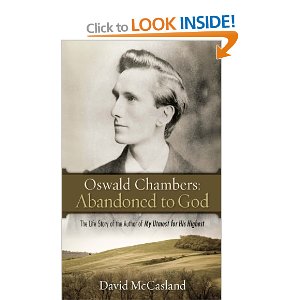
 
Oswald Chambers: Abandoned to God 
David McCasland

After meeting Oswald for the first time, one serious young man said, “I was shocked at his undue levity. He was the most irreverent Reverend I had ever met!”

A British soldier in Egypt described Chambers as, “ the personification of the Sherlock Holmes of fiction- tall, erect, virile, with a clean cut face, framing a pair of piercing bright eyes….a detective of the soul”

“A detective of the soul’ could not be a more apt description of Oswald, and of this book. It was published by his wife Biddy, after his death, taken from her verbatim notes on his teaching.  I have read and reread him over the years, using the book as a daily spiritual check up. He points me to the God he loved and trusted. He allows me no self pity in suffering, no self satisfaction in times of success. He pushes me onwards when I am flagging and encourages me always to give my utmost for God’s highest , as he endeavoured to do. 


As I have explored the rocky and dangerous territory of a vocation to ordination, he has been at my side, like a personal trainer, urging me on to more of God.
 
One of the CDs inspired by “My Utmost”

I have pressed this book into the hands of many friends over the years. Whether they too, have been enriched and blessed as I have been, by this man after God’s heart, I will never know.  What I do know, is that whatever steep climb or twisty valley you may be travelling, you couldn’t take a more worthy companion. 
I was asked to write this in response to the question “What  one Christian book has influenced you more than any other.. ( apart from the Bible) ”  Would love to hear what books you would name in this category.
 
This post originally appeared on Anita Mathais Blog Dreaming Beneath the Spires  where you can find other book reviews, by her guest bloggers answering this question.

I will restore to you the years the locusts have eaten (Joel 2:25): A Guest Post by Penelope Swithinbank

I can remember how it felt – that walking across the Square, arms stretched long with shopping bags.
I can remember how it felt  – that looking at our church, heart stretched hard and cold with unbelief.
I can remember: before coming to that church the years of losing everything – the business I had started, homes and cars and income, all lost; the worldly stuff I had held so dearly, gone.  Taken by God, vindictively it seemed.But then came this church.  Its large draughty  Victorian Rectory. My life turned upside down and not in the way I wanted. For I had enjoyed my status: 20th century vicar’s wives did not usually head up their own nationwide company. Gone. All gone.
I was tired, so tired of it all.
* * *
But then I remember: that clergy wives’ conference, days after crossing the Square. The reluctant going, the fear of being thought an abject failure, the hesitancy in case someone uncovered my unbelief. A speaker – who was she? And what did she have to say? Lost in time. But then, oh then, another speaker, who spoke creatively, humourously, and who then asked us to stand so the Lord could minister to us.
STAND? My hesitation – what was this about? My desire to melt away and not be part of this. And then finding myself standing, pulled by the Unseen Presence. His Light, flooding the room. His Warmth enveloping me in ways I could not comprehend. His Voice, unheard, speaking into my poor stretched heart: I am here, I am true, I am your strength.  I AM.
Their prayers for me, surrounding me. My tears falling.  Shaking with the overwhelming sense of His being with me. One stood back, pondered, allowed Him to speak through her voice.
“I wonder,” she said, “if this verse might be for you? Somewhere in the Old Testament I think. Words from the Lord.  I will restore to you the years the locusts have eaten.”
They prayed some more. He took those words deep into that cold stretched heart. He promised restoration, things that would replace what was lost, devoured and devastated. A swarm of things new and above what was lost.
So I clung to that verse over the years that were to come. Years with ups and downs, but years of fruitful ministry just as He had promised. A book was published, an international speaking gift confirmed, a ministry ordained. The years lost through unbelief were more than made up for. Always I remembered that verse. He had restored the years the locusts had eaten – and more.
* * *
And then.
Seventeen months ago, my mother died. Swept away. One moment she was there, a feisty ninety-year-young who cared ceaselessly for others, drove old ladies to church, talked non-stop on the phone to her friends and family whenever she could.  Prayed for us all, every day.
And the next she was gone, swept away under the wheels of an out-of-control car.
And I stood there, frozen, helpless. Stunned from having been hit by the same car just a few moments before. Deafened by the shouts and screams and sirens. Deafened by the silent scream inside. And my tears turned to ice and my scream frozen deep within.
She was gone.
I stood at her feet and I tried to pray for her, aloud.  Tried to thank God for all she was and had been to me and others; tried to ask Him to take her to Himself; committed her to the One who loved her the best. And the paramedic had tears in her eyes.  “I’ve never heard anyone pray out loud before,” she said.  “Would you like her teeth? And her watch?”
I took the watch and turned to thank the paramedics and the police and the passersby.  People were so kind; so very kind.
But I was frozen.
For seventeen month now, I have been frozen. Unable to work or to play, to read or to write. Lost, barren, devoured by locusts.
But now. A slow greening of tiny shoots again.
A decision to be grateful in the brokenness.*
A monthly Happiness Project.+
And confirmation from He whom my soul loves, that what has yet again been devoured by locusts will be restored to me.
The verse remembered.
That decision to have a monthly project – for March, to write again.
He promised.  And there was the verse, my verse: on Anita’s tweet. Her invitation on February 29 to write a guest blog.  And on March 1st an offer of a freelance writing project – very small but it’s writing and it’s paid! Unsought, it brought with it His Voice of Promise: I will restore to you the years the locusts have eaten.
Confirmation that my ministry years are not over, as I had feared.
He who has promised is faithful and He will do it. Again and again, whenever it is needed:
“I will restore to you the years the locusts have eaten.” Joel 2:25
*  One Thousand Gifts. Ann Voskamp. Zondervan ( Editor’s note: This book is wonderful, and well worth a look at – link through title)
+ A Happiness Project. Gretchen Rubin. Harper
*******
Penelope Swithinbank
The Revd Penelope Swithinbank is a widely recognized international conference speaker, both for Alpha and for retreats and pilgrimages.   Author of “Women By Design,” she has been involved in ministry for over 30 years, as pastor’s wife, volunteer, and now as a member of the ordained Anglican clergy.  As a young mother she started her own business, “Bumpsadaisy” which she developed into a successful national franchise across the UK, hiring out designer maternity wear.  Later, whilst working virtually full time as a volunteer in the church, she ran a flourishing Bed & Breakfast business to help pay the bills! She has three children and six grandchildren.Penelope  and her husband lived in the USA for six years.  Whilst there, Penelope was firstly Director of C2 Ministries (Community & Connections) at The Falls Church in northern Virginia, and then Interim Rector of The Church of Our Saviour, Johns Island in South Carolina. Now based in London, she runs “Ministries by Design” and leads Retreats and Pilgrimages regularly, and is an Ignatian Spiritual Director, and mentor to younger women clergy.Penelope has a Master of Theology from St Andrews University Scotland, and degrees in both Education and Pastoral Theology from Cambridge University, England. Find full details on the website or follow her on twitter:www.ministriesbydesign.org
@minstriesbydsgnDreaming beneath the Spires
This is a reblog of a guest post on http://dreamingbeneaththespires.blogspot.com/  an excellent blog worth following on twitter or elsewhere. @AnitaMathias1 is a wonderful collector of resources and links as well as being another writer worth reading.

The power of Story

The Oscars.  “The movies have always been there for us. They’re the place to go to laugh, to cry, to question, to text. So tonight, enjoy yourselves because nothing can take the sting of the world’s economic problems like watching millionaires present each other with golden statues.” Billy Crystal. Since the advent of the cinema, celluloid has been an escape, a storybook come to life. However, stories can hold our dreams, our griefs, and our questions, like no other medium of communication. Skilled writers, photographers and actors can slip past our defences and reshape the way we think and feel, through the power of story. Nick Baines has also recently reflected on story.  Jesus may not have had cinema, but he spoke in stories. No wonder they said of him, “No one speaks like this man”.  The more I study them, I am sure that the parables we have, are merely the bones of the stories he told. Like the best of storytellers he would have fleshed them out with passion and imaginative details, with colour and tone and dramatic pause. He was the master of surprise, speaking of familiar things, readily accessible and adding a very different twist.

I love films that move me and make me think. ( I also love films that you bury your brain under the seat and enjoy fun and laughter)  I have seen a few recently, that made a deep impression on me. No surprise to anyone, of the first of these was  ‘The Artist’ , which in my view, deserves all the accolades it gets. A beautifully crafted film, creating so many layers of meaning and depth. I went, expecting it to be a light hearted ‘fluffy’ film about the 20’s and 30’s, the time of the transition from Silent Movies to The Talkies. What I got was a touching film where communication was by expression and micro-gesture. The absence of words left a lot of room for thought and interpretation.  It spoke alot to me about priesthood. Being a public person,  and handling both sides of  ‘fame’. How you view yourself, and how others see you, good and bad. Being a ‘rising star’ a newcomer, or a ‘has been’ where all you trained for is suddenly disappearing beneath your feet. Adapt or you are last weeks news. The touches of humour sprinkled through it heightened the pathos. You can take it at any level you like, and I defy anyone not to enjoy it. Definitely a ‘must see’.

The next film was Shame.  A sensitively produced picture of  the very real and complex problem of sex addiction. A review said, “Shame is captivating and intensely intimate. McQueen has followed up Hunger with an unflinching and compelling film that explores the depths of addiction and the consequential destruction and demise of the mind and although it is sometimes difficult to watch, you won’t be able to keep your eyes off it.”  I couldn’t agree more. Not an easy film, not an easy subject, but that was the point. Like his film Hunger, the co-writer and director Steve Mcqueen intended to bring out into the light a hidden and painful issue.  Michael Fassbender, McQueen’s acclaimed lead actor in Hunger, was apparently, the first and only choice to play the lead role in Shame. He played it exceptionally well, with great depth and insight. Anyone who came expecting cheap titillation would have left disappointed, from this intensely moving film. I applaud McQueen’s compassionate motivation in writing and directing this story and for crafting it with such sensitivity and skill.

Prayers for Bobby’  is another difficult film to watch.  The synopsis on the website for the film probably says it all.

“Prayers for Bobby is the amazing true story of a mother torn between her loyalties, challenged by her faith, and moved by a tragedy that would change her life, and the lives of others, forever.

Bobby Griffith (Ryan Kelly, Smallville) was his mother’s favorite son, the perfect all-American boy growing up under deeply religious influences in Walnut Creek, California. Bobby was also gay. Struggling with a conflict no one knew of much less understood Bobby finally came out to his family. Despite the tentative support of his father, two sisters, and older brother, Bobby’s mother, Mary (three time Academy Award nominee and Golden Globe winner Sigourney Weaver, Avatar, Working Girl), turned to the fundamentalist teachings of her church to rescue her son from what she felt was an irredeemable sin. As Mary came closer to the realization that Bobby could not be “healed,” she rejected him, denying him a mother’s unconditional love, and driving her favorite son to suicide.

Anguished over Bobby’s death, Mary finds little solace in her son’s poignant diaries, revelations of a troubled boy fighting for the love of his mother and God. Finding it difficult to reconcile her feelings of guilt, her conflicted emotions over religious teachings, and her struggles with understanding her son’s orientation, Mary finally, and unexpectedly, reaches out to the gay community as a source of inspiration and consolation. For Mary Griffith, it’s the beginning of a long and emotional journey that extended beyond acceptance to her viable role a vocal advocate for gay and lesbian youth. In 1996, twelve years after Bobby’s death, she was invited to address the Congress of the United States, establishing her as a major force in the fight for human rights.”

Prayers for Bobby

Image via Wikipedia

In a church where this subject is such a divisive issue,  I tread softly on what is very tender ground. I have seen the emotions on both sides of the debate, and this searingly honest  film shows a range of them.  Any hope of reconciliation of polemically held views, requires understanding of the other person’s perspective. To ‘walk a mile in their shoes’ and to feel the loads they carry. I feel this film goes some way to helping this to happen. The debate is not a safely packaged theoretical argument – it is played out very painfully within the realities and struggles of a real family who have to live with the consequences. I firmly commend it to anyone to see, and particularly to anyone in ministry or church leadership.   You can make your own mind up about how it leaves you, of course, but for me, looking away wasn’t an option.